Skip to main content arrow_circle_down
Harvard University
中國歷代人物傳記資料庫(CBDB)
中國歷代人物傳記資料庫(CBDB)
  • 首頁
  • 關於我們
    • 歷史
    • 編輯委員會
    • 資助機構
    • 合作機構與個人
    • 各歷史時期的工作小組
    • 技術小組
    • 哈佛小組子項目
    • 哈佛過往子項目
    • 眾包項目
    • 開源社區(GitHub)
    • 獨家商業授權
  • 方法論
    • 群體傳記學
    • 地理資訊系統
    • 社會網路關係
  • 資料來源與涵蓋範圍
    • CBDB的收錄原則
    • 資料來源
    • 涵蓋範圍
    • 資料庫架構
  • 研討會
    • “中古中國的群體傳記學”國際學術研討會 (2007)
    • 中國歷史人物傳記數據庫第一屆國際學術工作坊 (2008)
    • “中國史研究與計算機技術”國際學術工作坊暨2010年度宋史研習班
    • 2013 唐代研究工作坊
    • 世界各地的中國歷代人物傳記資料庫研討會
    • 2016年cbdb的介紹與資料庫的使用專題演講
  • 下載
    • 下載CBDB單機版
    • 下載教學與輔助文件
    • 下載投影片與論文
    • 下載相關軟體
    • CBDBRegexMachine
    • 資料集
    • CBDB API
    • CBDB 關聯數據
    • 錯誤回報
  • 博客
    • 最新 blogs
    • 往期 blogs
  • English

Breadcrumbs

  1. Home chevron_right
  2. Galleries chevron_right
  3. About the Biographical Database for the 2nd - 7th Centuries

About the Biographical Database for the 2nd - 7th Centuries

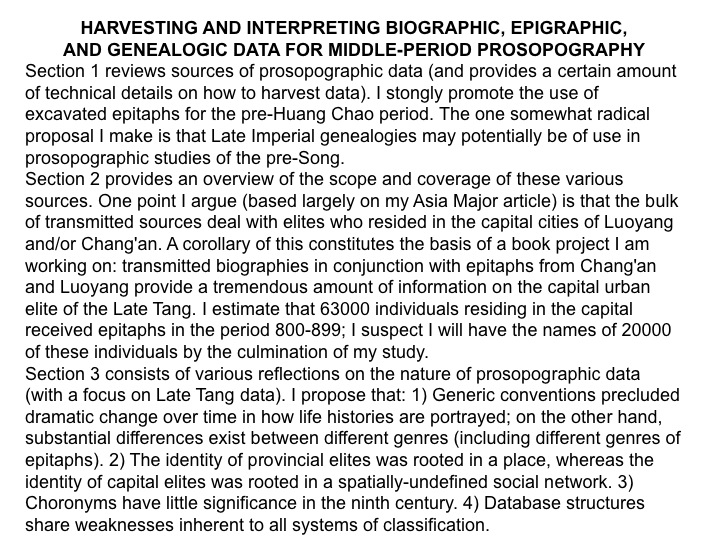
Abstract slide on harvesting and interpreting biographic, epigraphic and genealogic data for middle-period prosopography, in three sections.
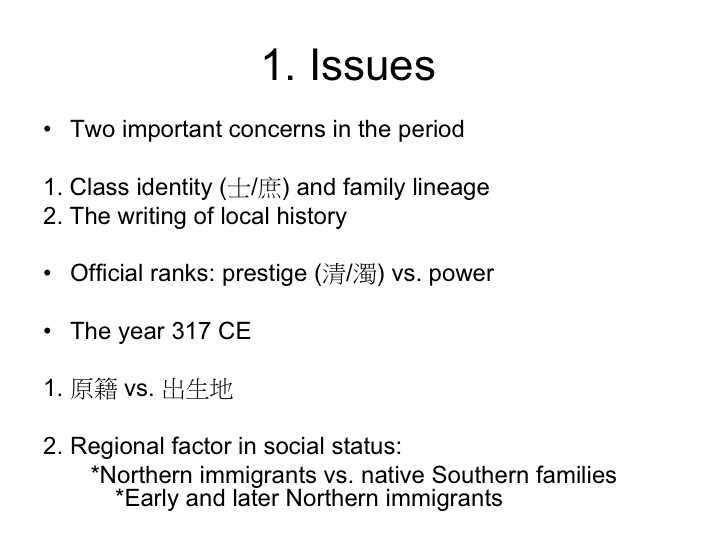
Slide '1. Issues': class identity and lineage, local history writing, prestige versus power in office, the year 317, native place versus birthplace, region.
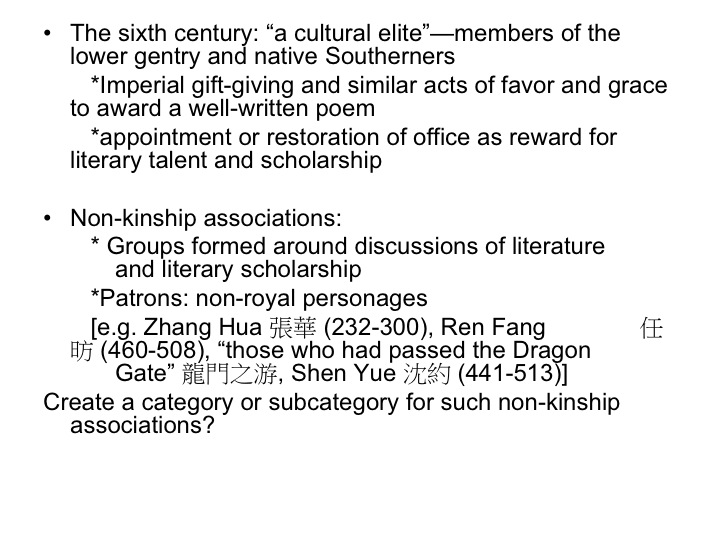
Slide continued: a sixth-century cultural elite of lower gentry and native Southerners; non-kinship associations formed around literature, with named patrons.
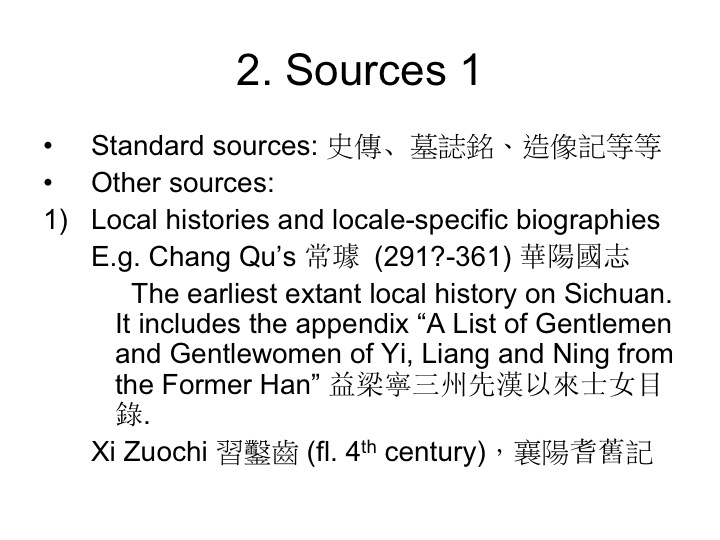
Slide '2. Sources 1': standard sources are histories, epitaphs and image inscriptions; other sources include local histories such as Chang Qu's Huayang guo zhi.
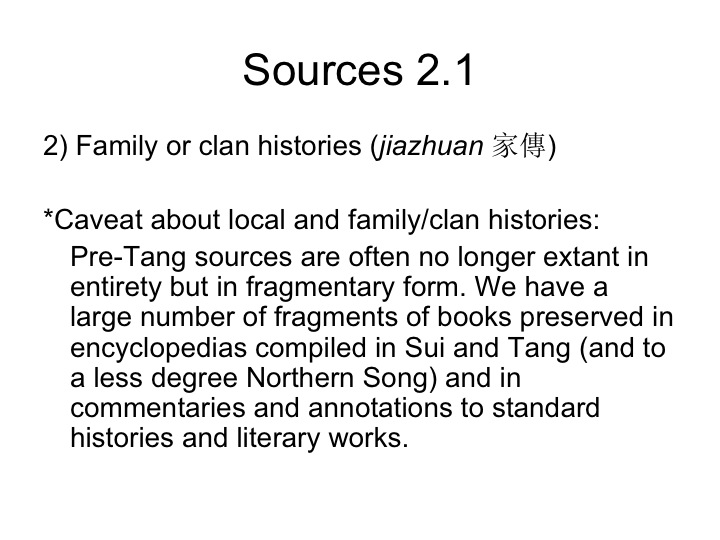
Slide 'Sources 2.1': family or clan histories, with the caveat that pre-Tang sources survive only as fragments quoted in later encyclopedias and commentaries.
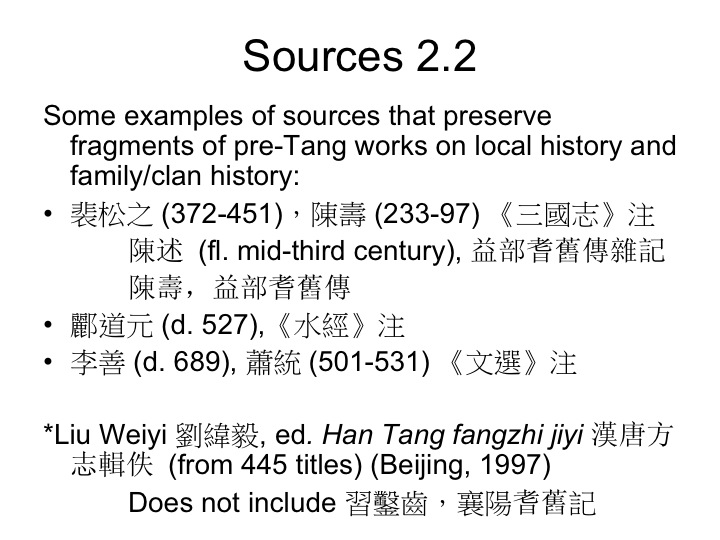
Slide 'Sources 2.2': examples preserving pre-Tang fragments - commentaries by Pei Songzhi, Li Daoyuan and Li Shan - and Liu Weiyi's collection from 445 titles.
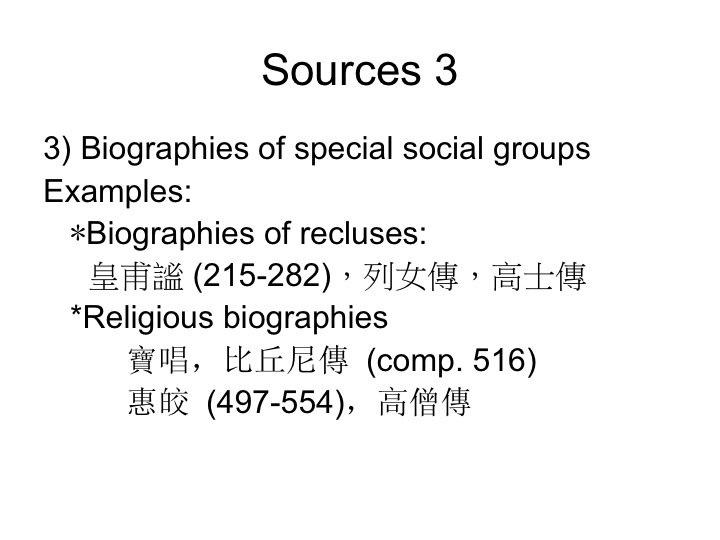
Slide 'Sources 3': biographies of special social groups, such as Huangfu Mi's lives of recluses and religious biographies of nuns and eminent monks.
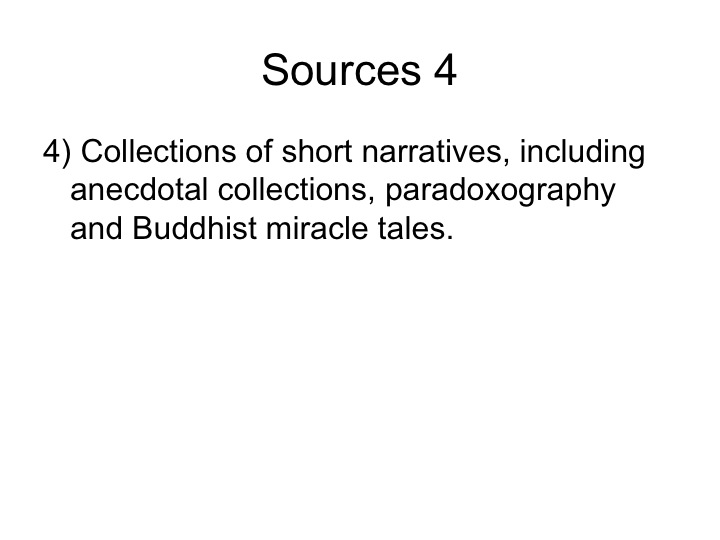
Slide 'Sources 4': collections of short narratives, including anecdotal collections, paradoxography and Buddhist miracle tales.
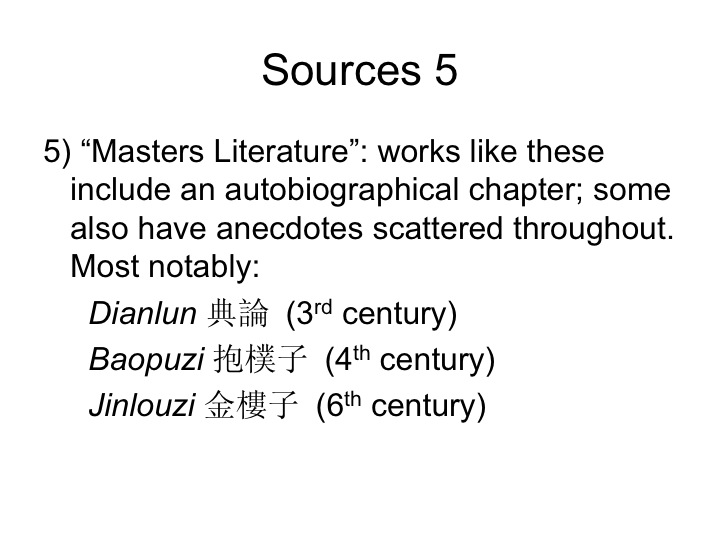
Slide 'Sources 5': masters literature, which often includes an autobiographical chapter - the Dianlun, Baopuzi and Jinlouzi.
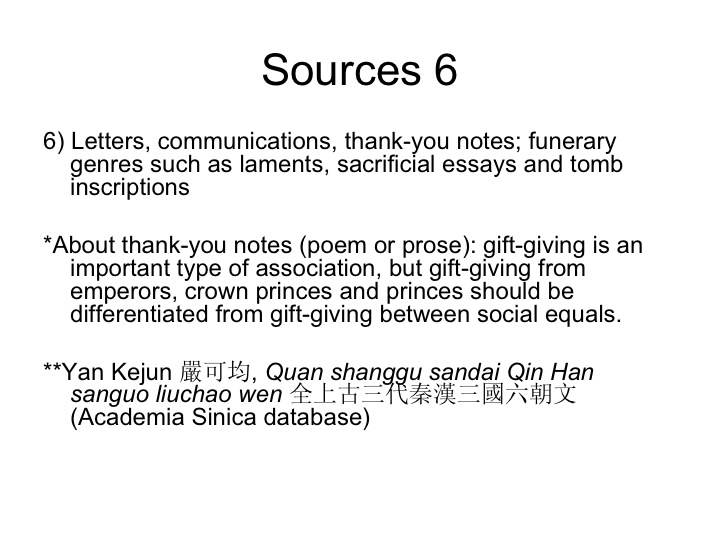
Slide 'Sources 6': letters, thank-you notes and funerary genres; a note that gift-giving by emperors must be distinguished from gifts between social equals.
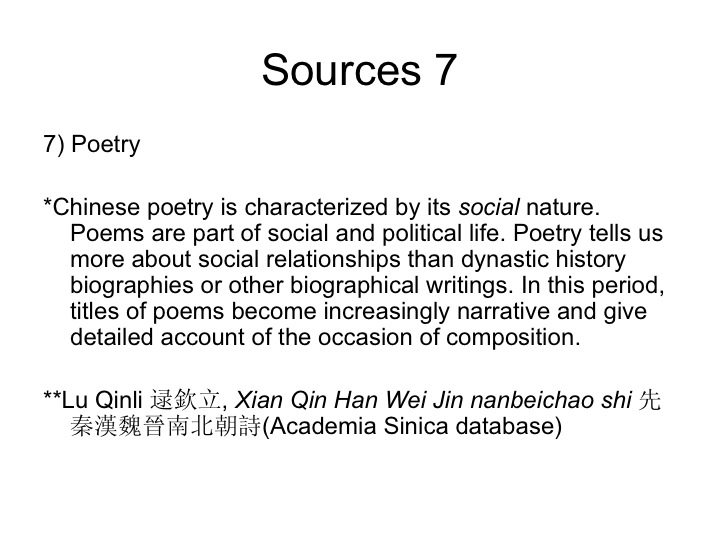
Slide 'Sources 7': poetry, whose social nature tells more about relationships than dynastic histories, with poem titles increasingly narrative in this period.
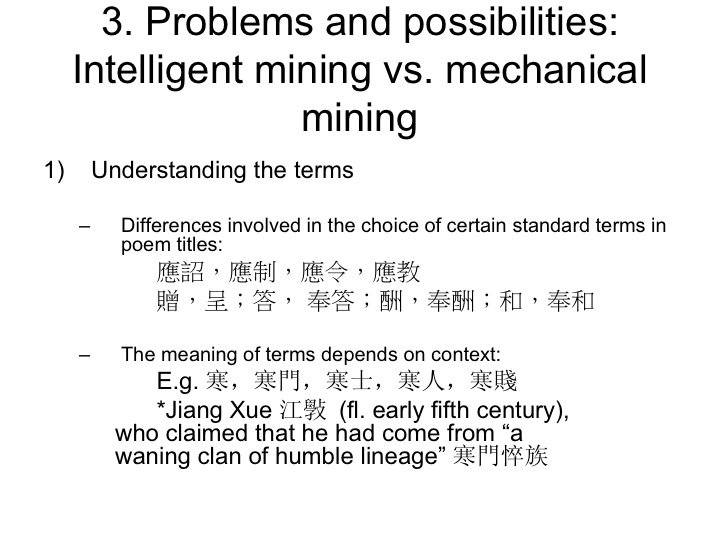
Slide '3. Problems and possibilities: intelligent versus mechanical mining': terms in poem titles differ subtly, and their meaning depends on context.
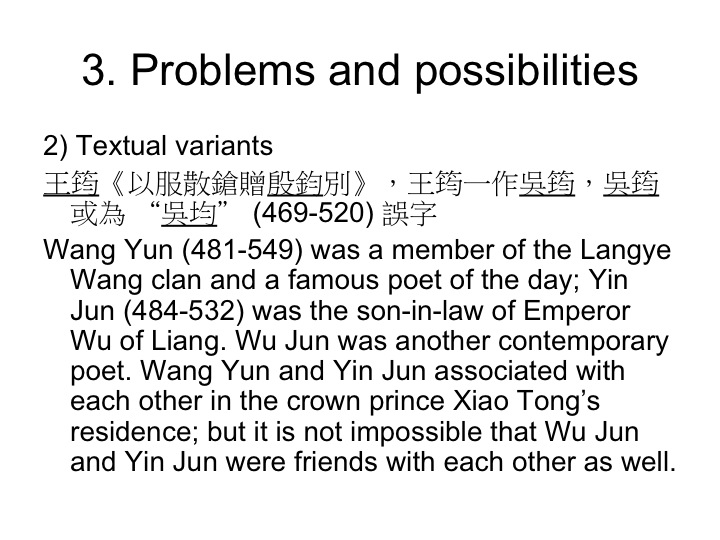
Slide on textual variants: Wang Yun's name is also written Wu Yun, and the poem's dedicatee Yin Jun may be a miscopying, which changes who associated with whom.
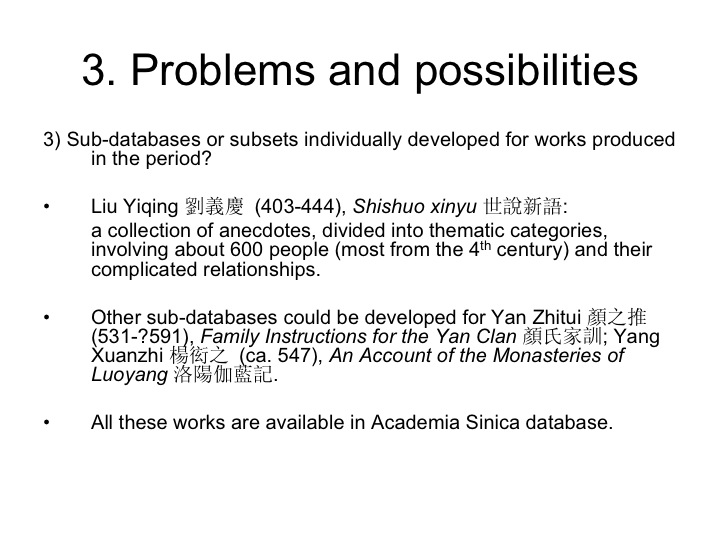
Slide on sub-databases for individual works: Liu Yiqing's Shishuo xinyu covers some 600 people, and others could be built for the Yan clan instructions.
See also:
  • Modeling Life Histories of the Han and the Medieval Dynasties (Xiaofei Tian)
Harvard Faculty of Arts and Sciences

©中國歷代人物傳記資料庫。除特別註明,本網站其他內容遵守非商業性使用-相同方式共享 4.0 國際許可協議 (CC BY-NC-SA 4.0)。

Admin login
Harvard University
Copyright © 2026 The President and Fellows of Harvard College
Accessibility Digital Accessibility Report Copyright Infringement Info Practices